Last Updated on March 10, 2021 by Simon Fan
The majestic Yellow Mountain, a Unesco world heritage site with breathtaking scenery, is the birthplace of Hui Cuisine, one of the best regional cuisines in China.
The mountains, forests, rivers, and lakes in the region provide an abundant supply of wild games, fresh-water fish, mushrooms, bamboo shoots, and numerous exotic herbs and plants—all of which are frequently featured in Hui Cuisine.
Unlike some other regional cuisines that tend to emphasize elaborate cooking techniques, complex flavoring, or delicate knife works, Hui Cuisine excels at using simple cooking methods such as stewing and steaming to create light and subtle dishes that highlight the natural flavors of the ingredients.
Of course, being simple doesn’t mean being simplistic. The amount of heat applied in cooking is masterly controlled in Hui Cuisine.
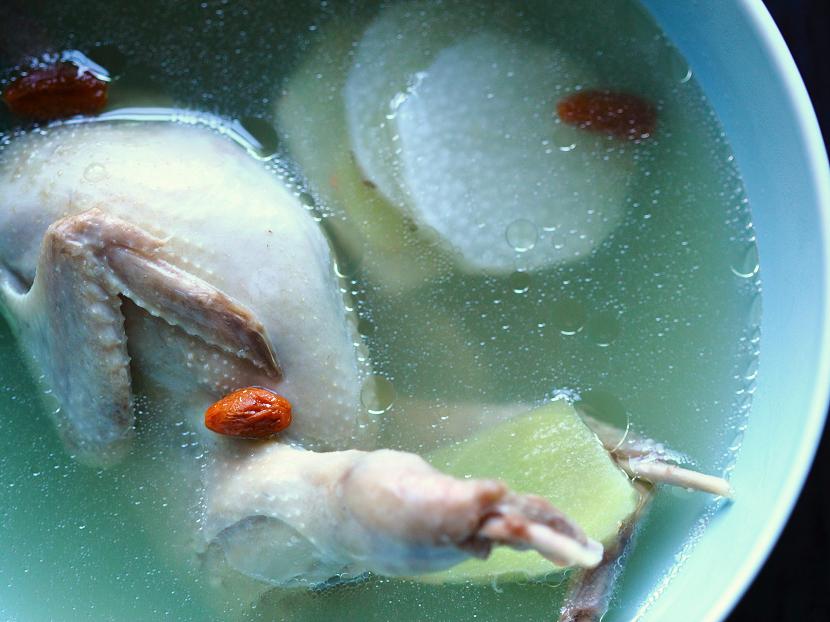
Take Yellow Mountain steamed squab soup (黄山炖鸽), one of its iconic dishes, for example. The soup is steamed in a covered vessel (tureen), a technique known as ge shui dun (隔水炖) in Chinese cooking. It’s a great way for cooking delicate ingredients or making tonic soups.
The main ingredients of this dish, squab and Chinese yam, are submerged in chicken stock in a tureen, which is then placed in a wok or pot filled with water about halfway up the side of the tureen. As the water in the covered wok is heated up and kept at a gentle boil for several hours, the ingredients inside the tureen are heated through gradually and evenly, producing a very juicy and tender bird and a clear, delicate soup.
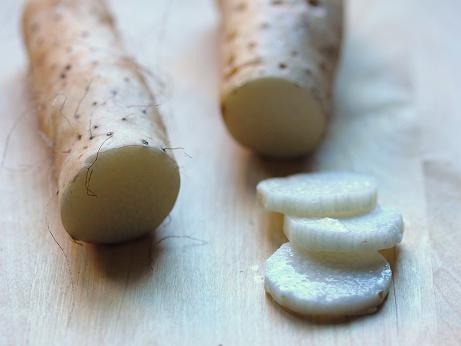
Chinese yam renders the soup a subtle sweetness and herbal aroma. Known as shan yao (山药) in Mandarin, meaning “mountain medicine,” Chinese yam has medicinal properties such as strengthening qi and increasing vitality according to Traditional Chinese Medicine (TCM).
The recipe below is an adaptation from Yellow Mountain steamed squab soup by using quail, a smaller bird, in place of squab to significantly reduce the cooking time, so I can have my restorative soup ready in one hour. And so can you!
Steamed quail and Chinese yam soup, Hui style
Serves 2
Ingredients
4 oz (115 g) Chinese yam, peeled and cut crosswise into ¼-inch-thick (6 mm) slices
2 whole quails with innards removed
1 scallion white
½-inch (1.3 cm) piece of ginger, thinly sliced
6 Goji berries
1 teaspoon Shaoxing wine
2 cups (480 ml) chicken stock or water, plus more as needed
Salt and freshly ground white pepper
Directions
- Blanch the Chinese yam slices in boiling water for 20 seconds. Drain and pat dry.
- Blanch the quails in boiling water for 1 minute. Rinse under cold water to remove any scum, drain well, and pat dry.
- Place the quails and Chinese yam in a tureen (or a deep heatproof bowl). Add the scallion, ginger, goji berries, and wine. Add the stock to fully submerge the ingredients. Cover the tureen (or cover the bowl with a lid or aluminum foil). Place it in the center of a wok or pot, and fill the wok with water about halfway up the side of the tureen. Cover the wok with a lid.
- Bring the water to a boil, then reduce the heat to maintain a gentle boil, making sure the water does not get into the tureen while cooking. Cook until the quails are cooked through and tender (replenishing the water in the wok as needed), about 1 hour.
- Season to taste with salt and pepper. Divide the quails, Chinese yam, and soup between two serving bowls and serve right away.

Steamed pearl meatballs in glutinous rice (珍珠丸子) | Soy, Rice, Fire
August 30, 2020 at 9:46 PM[…] dishes that highlight the natural flavors of the ingredients. This meatball dish, together with Steamed quail and Chinese yam soup, which I posted previously, exemplifies the essence of Hui […]
Steamed iron stick yam with osmanthus syrup (桂花山药) | Soy, Rice, Fire
March 11, 2021 at 10:12 AM[…] it’s great eaten raw or briefly stir-fried. It’s also used to make clear tonic soups, as in steamed quail and Chinese yam soup, Hui style. By comparison, the thinner iron stick yam is starchier and slightly sweeter. It’s often steamed, […]